
AI Attorney and the ABA Rules of Professional Conduct
Using an AI attorney does not change a lawyer’s ethical duties — the same ABA Model Rules of Professional Conduct still apply. In July 2024 the American Bar Association issued Formal Opinion 512, its first formal ethics guidance on generative AI (GAI) tools.
This guide walks through how competence, confidentiality, candor, supervision and fees map onto an AI legal assistant, according to the American Bar Association.

Note: This article is for general information only. An AI attorney tool does not replace a licensed lawyer and its output is not legal advice — always verify AI-generated content and consult a licensed attorney for advice on your specific situation.
What ABA Formal Opinion 512 Says
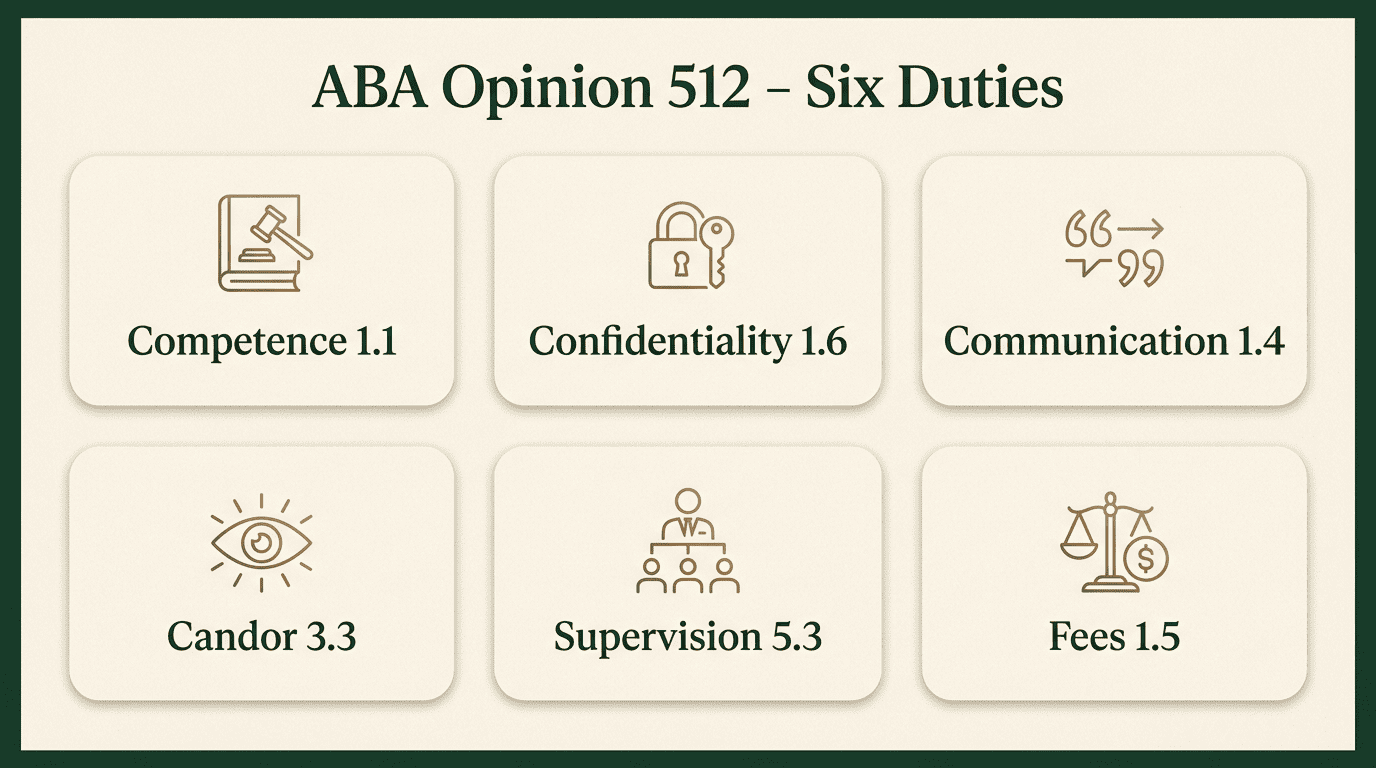
The ABA Standing Committee on Ethics and Professional Responsibility released Formal Opinion 512 on July 29, 2024 — the association’s first formal guidance on generative AI. It does not create new rules; it applies existing Model Rules of Professional Conduct to AI tools. Six duties fall in scope: competence (1.1), confidentiality (1.6), communication (1.4), candor to the tribunal (3.1/3.3), supervision (5.1/5.3) and reasonable fees (1.5).
The first ABA ethics opinion on generative AI
Before Opinion 512, lawyers experimenting with a generative AI legal tool had no dedicated ethics roadmap — only the general Model Rules, written decades before large language models existed. The opinion closes that gap by translating each duty into AI-specific terms, drawing on the same Model Rules of Professional Conduct that already bind every licensed attorney in the United States.
Model Rules, not a ban
The opinion neither mandates nor bans AI use. It signals that ignorance of a tool’s benefits and risks is not an acceptable posture for a practicing lawyer — silence on AI is treated the same as silence on any other piece of legal technology. The six duties Opinion 512 maps onto generative AI are:
- Competence (Rule 1.1) — understand a tool’s capabilities and limits
- Confidentiality (Rule 1.6) — protect client information from disclosure
- Communication (Rule 1.4) — tell clients when AI use is material
- Candor to the tribunal (Rules 3.1/3.3) — verify every citation
- Supervision (Rules 5.1/5.3) — oversee AI like a nonlawyer assistant
- Reasonable fees (Rule 1.5) — bill actual time only
Duty of Competence: Model Rule 1.1
Model Rule 1.1 requires the “legal knowledge, skill, thoroughness and preparation reasonably necessary” for representation. Comment 8 extends this duty to keeping abreast of “the benefits and risks associated with relevant technology,” and Opinion 512 applies that language directly to generative AI.
Lawyers need not become GAI experts. Opinion 512 clarifies that attorneys aren’t expected to master the underlying architecture of a large language model — they must understand a tool’s capabilities, its limitations, and where it tends to fail, similar to how a lawyer understands e-discovery software without writing the code.
Every AI output needs independent verification. Relying on inaccurate output from a generative AI legal tool without checking it against primary sources can itself constitute a competence failure, and in litigation, malpractice exposure.
Training is now part of the job. The opinion expects lawyers to invest time understanding a given AI attorney tool’s error rate and typical failure modes before relying on it for client work, the same way they’d learn a new case-management platform.
| Model Rule | Core Requirement | AI-Specific Application |
|---|---|---|
| 1.1 Competence | Reasonable skill and preparation | Understand AI tool’s capabilities and risks; verify output |
| 1.6 Confidentiality | Protect representation-related information | Vet self-learning tools; review Terms of Use |
| 3.3 Candor to Tribunal | Truthful representations to the court | Verify every citation before filing |
| 1.5 Fees | Charge only reasonable fees | Bill actual time, not time the tool saved |
Confidentiality and Informed Consent: Model Rule 1.6
Rule 1.6 protects “all information relating to the representation” of a client, and Opinion 512 treats self-learning generative AI tools as a distinct confidentiality risk rather than a generic technology concern.
Why self-learning AI is the risk
Self-learning tools that train on user inputs raise the chance that one client’s confidential data could later surface in output generated for another user. Formal Opinion 512 warns that such tools are designed in a way where information entered “could lead directly or indirectly to the disclosure” of confidential material to outside parties, including the AI company itself or other users of the platform.
Because many of today’s self-learning GAI tools are designed so that their output could lead directly or indirectly to the disclosure of information relating to the representation of a client, a client’s informed consent is required prior to inputting information relating to the representation into such a GAI tool.
ABA Formal Opinion 512
Boilerplate consent is not enough
Opinion 512 states that generic engagement-letter waivers are inadequate for AI-related disclosures; clients need a specific explanation of what information could be disclosed and how it might be used. Before entering client information into an AI legal assistant, lawyers should review the tool’s Terms of Use and privacy policy, and may need to consult IT or cybersecurity professionals. The confidentiality mechanics of a given tool — including how AI lawyer confidentiality and privilege actually work in practice — are worth reviewing before any sensitive matter touches the platform.

Before inputting anything client-related into a generative AI legal tool, a lawyer should check:
- Whether the tool trains on user inputs or is a self-learning model
- What the Terms of Use and privacy policy say about data retention
- Whether the vendor offers an enterprise or opt-out mode
- Whether client-specific informed consent is needed, not a boilerplate waiver
Candor and Verification: Model Rule 3.3
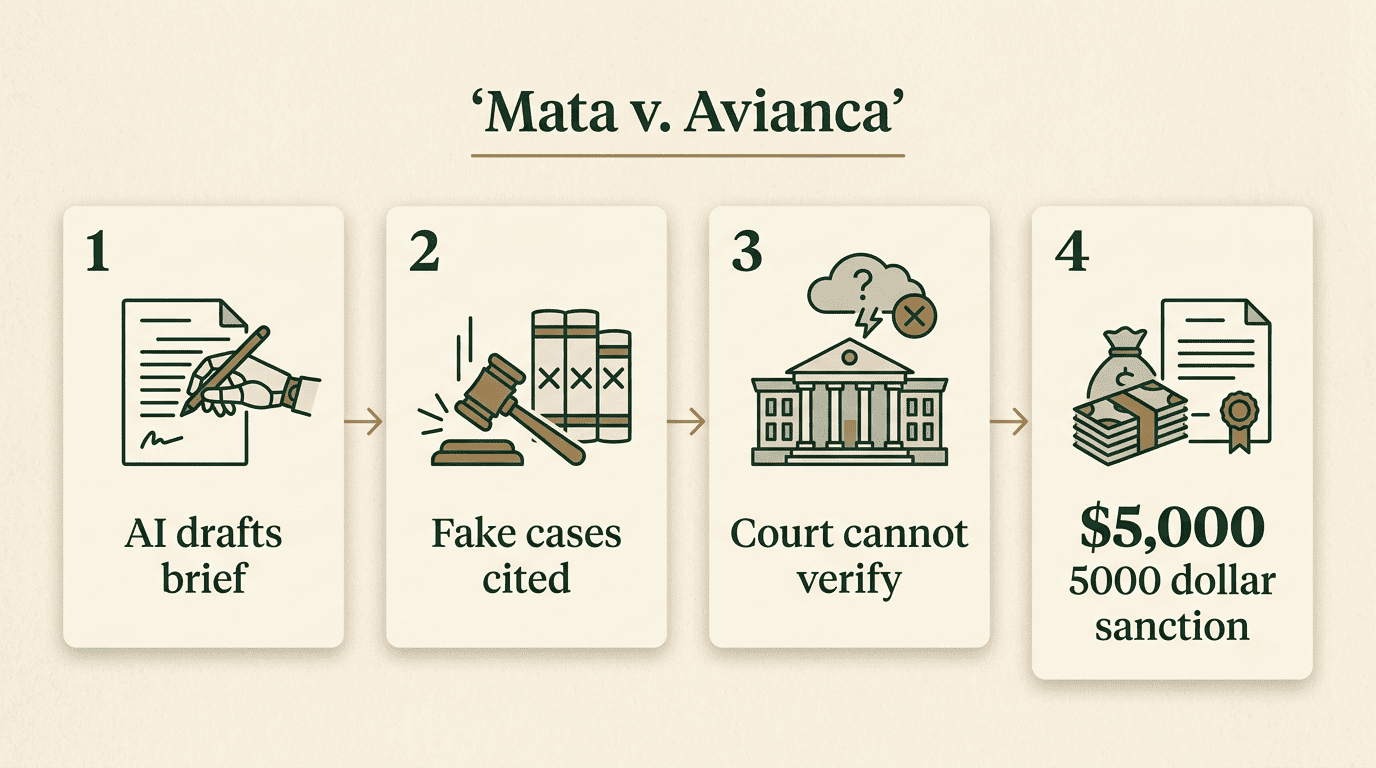
The most cited cautionary tale in Opinion 512-era commentary is Mata v. Avianca, a case that made the candor duty concrete for every lawyer using a generative AI legal tool.
- A lawyer used ChatGPT to research case law for a personal-injury brief.
- The tool generated citations to cases that do not exist — a phenomenon commonly called AI hallucination, examined in more depth in the growing body of AI attorney hallucinations case law.
- The brief was filed in the Southern District of New York without independent verification of the citations.
- Opposing counsel could not locate the cited cases in any legal database.
- The court ordered the lawyers to produce the actual case opinions.
- Judge P. Kevin Castel found the filing was made in bad faith under Federal Rule of Civil Procedure 11.
- The court imposed a $5,000 sanction on the attorneys and their firm.
The Mata v. Avianca warning
In Mata v. Avianca (S.D.N.Y. 2023), two lawyers submitted a brief citing fabricated cases generated by ChatGPT. Judge Castel sanctioned them $5,000, finding bad faith under Rule 11. The lesson courts have repeated since: an AI attorney’s output is a draft, and the lawyer who signs it is accountable for every word.
Duty to the court
Rule 3.3 requires candor toward the tribunal — every citation, quotation and factual assertion generated by an AI legal tool must be verified against a primary source before it reaches a filing.
Fees and Supervision: Rules 1.5 and 5.3
Two smaller but frequently overlooked duties round out Opinion 512’s framework: how lawyers bill for AI-assisted work, and how they supervise the tool doing it.
Billing for AI time. Under Rule 1.5, lawyers may bill only for actual time spent. Opinion 512 is direct on this point: “A fee charged for which little or no work was performed is an unreasonable fee.” A lawyer may bill for the minutes spent prompting an AI attorney tool and reviewing its draft, but not for the hours the tool saved compared to manual research.

AI as a nonlawyer assistant. Rules 5.1 and 5.3 frame generative AI in managerial and supervisory terms: a lawyer must oversee an AI tool’s work much as they would a paralegal or other nonlawyer assistant, ensuring the output conforms to the lawyer’s professional obligations before it reaches a client or the court.
Under Opinion 512, a lawyer may bill for:
- Time spent crafting and refining prompts for a specific matter
- Time spent reviewing and editing an AI tool’s draft output
- Time spent verifying citations and facts the tool produced
A lawyer may not bill for the time the AI tool saved compared to doing the work manually, or for general time learning a tool absent a client-specific request to use it.
| Duty | Rule | What It Requires With AI |
|---|---|---|
| Communication | 1.4 | Disclose AI use when a client asks or when it affects fees |
| Fees | 1.5 | Bill actual time only, not time the AI tool saved |
| Supervision | 5.1 / 5.3 | Treat AI output like nonlawyer assistant work |