
AI Attorney: What It Is, What It Can Do, and When You Still Need a Human Lawyer
An AI attorney is an AI-powered legal assistant — software built on large language models — that answers legal questions, drafts and reviews documents, and researches case law in seconds, around the clock. The idea sits inside a broader shift often called legal technology, and it’s reshaping how people get a first read on a legal problem before ever calling a firm.
It is not a licensed lawyer. This article is for general information only and does not constitute legal advice: an AI legal assistant cannot represent you in court, cannot give you the professional accountability a bar license carries, and should not be treated as a substitute for a licensed human attorney on anything with real stakes. Think of it as a fast, low-cost first step — useful alongside a lawyer, not instead of one, once a matter gets complicated.

What Is an AI Attorney and How It Works
An AI legal assistant is software trained on legal and general-purpose text that reads a plain-language question and answers it with reference to relevant rules, statutes, or contract language. Some tools are built for consumers — chatbots that explain a lease clause or draft a demand letter — while others, like Clio or CoCounsel, are built for law firms to speed up internal work. The line between an “AI lawyer” and a general chatbot is thinner than it looks: many people simply use ChatGPT, Claude, or Gemini for legal questions instead of a purpose-built legal AI chatbot.
The technology behind AI legal assistants
Under the hood, these tools run on the same class of model — a large language model — whether they’re marketed as general-purpose or “legal-specific.” General consumer products like ChatGPT Plus, Claude Pro, and Gemini Advanced run roughly $20/month and handle everyday legal questions well. Legal-specific platforms add features like citation-checking, matter management, and document templates, usually at a higher subscription tier aimed at firms rather than individuals.
AI attorney vs. human attorney: the core difference
The gap isn’t knowledge — it’s authority and accountability. A large language model performs pattern recognition on text; a licensed attorney exercises legal judgment and carries a professional duty to the client. No AI tool has sat for a bar exam in a legal sense, taken an oath, or carried malpractice insurance, and no U.S. jurisdiction authorizes an AI system to practice law. The comparison below lays out where each side actually stands.
| Capability | AI attorney | Licensed human attorney |
|---|---|---|
| Answers legal questions instantly | Yes, 24/7 | Only during business hours / by appointment |
| Represents you in court | No | Yes |
| Carries malpractice insurance | No | Yes, typically required |
| Bound by attorney-client privilege | No | Yes |
| Drafts routine documents (NDAs, letters) | Yes, in seconds | Yes, billed hourly |
| Legally accountable for advice given | No | Yes |
Despite that authority gap, top language models have scored remarkably well on legal knowledge benchmarks — a May 2025 study that tested 59 language models on Multistate Bar Exam practice questions found more than two-thirds of them scoring above the average human test-taker. The knowledge is there; the license and liability are not.

What an AI Attorney Can Do
Most consumer AI legal tools cluster around three jobs: answering questions, producing paperwork, and doing research. Lawyers themselves report billing only about three of eight working hours on substantive legal work — the rest is administrative and research overhead that AI tools are increasingly absorbing.
Answering legal questions 24/7. An AI attorney gives instant, plain-language answers on everyday legal problems — helping someone understand their rights and options before they ever book a paid consultation, which typically runs $150–$400 just to walk in the door. Common topics include:
- Rental and landlord-tenant disputes
- Workplace and employment issues
- Debt collection and traffic tickets
- Family law questions
- Inheritance and estate basics
Drafting and reviewing legal documents. These tools produce first drafts of routine paperwork and flag risky or unusual clauses in an existing agreement, including:
- Non-disclosure agreements (NDAs)
- Contracts and vendor agreements
- Demand letters
- Complaint and dispute templates
In a widely cited 2018 LawGeex benchmark pitting AI against 20 experienced corporate lawyers, the AI system caught issues in NDA review more accurately than the human lawyers did — 94% versus 85% — and finished in 26 seconds against an average of 92 minutes per lawyer.
Legal research and case preparation. An AI legal assistant can summarize statutes and precedent, structure the facts of a situation, and generate a list of questions to bring into a meeting with a real lawyer. This isn’t a fringe use case: Clio’s 2025 Legal Trends Report found that 79% of lawyers already use AI tools in their own practice, meaning a consumer using the same category of tool is working with technology the profession itself has adopted.
How Much an AI Attorney Costs vs. a Human Lawyer
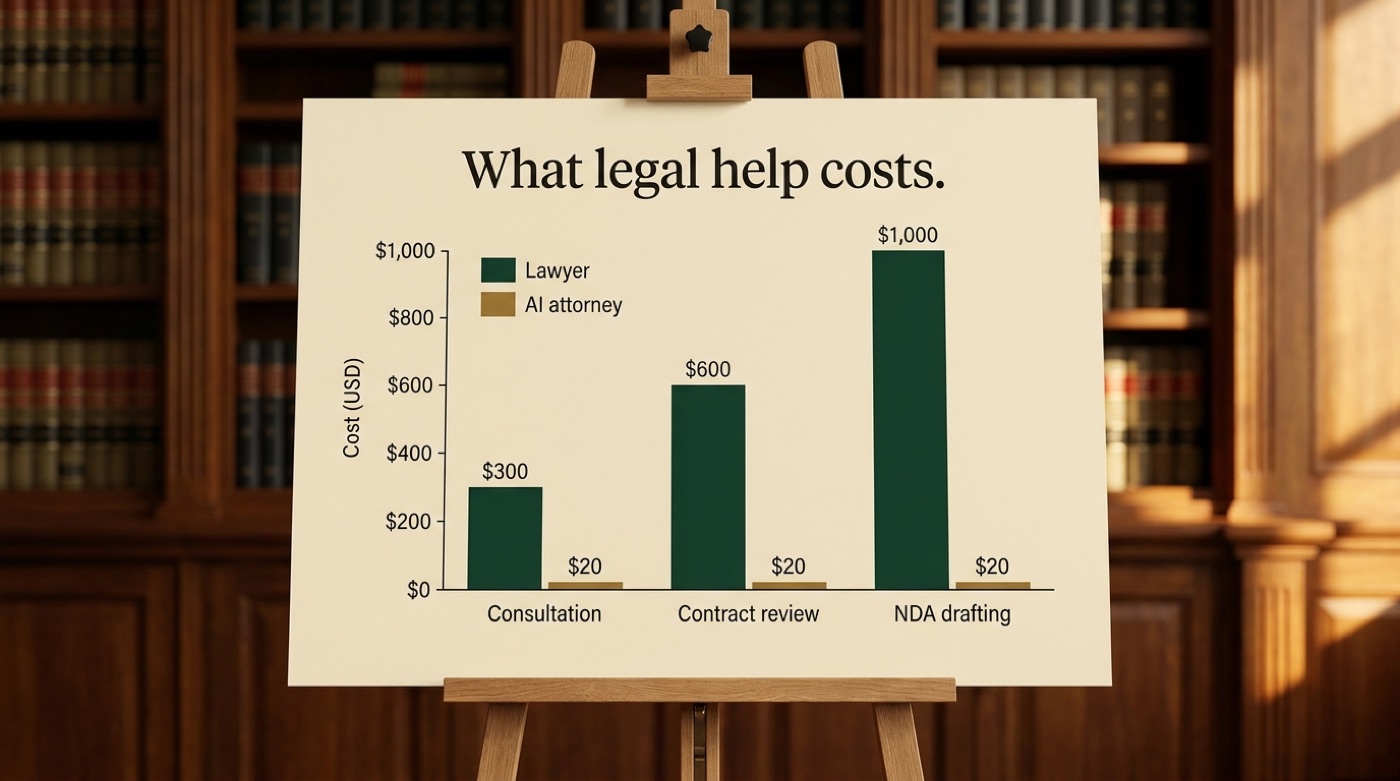
The price gap between an AI legal assistant and a traditional attorney is the single biggest reason people try one first. A solo attorney typically bills $200–$400 an hour, a BigLaw partner can run $1,500–$3,000 or more, and even a short consultation costs $150–$400 before any work begins. An AI attorney subscription, by contrast, runs anywhere from free to about $200 a month — and many everyday tasks need only the free or entry tier.
The table below lines up typical costs side by side for common legal tasks.
| Task | Human attorney | AI attorney |
|---|---|---|
| Initial consultation | $150–$400 | Free–$20/month |
| NDA drafting | $500–$1,500 | Included in subscription |
| Contract/lease review | $300–$800/hour | Included in subscription |
| Privacy policy drafting | $1,000–$3,000 | Included in subscription |
| Trademark filing assistance | $1,500–$4,000 | Included in subscription (filing itself still requires a professional) |
On routine paperwork, an AI legal assistant can be 20 to 100 times cheaper than hiring a lawyer by the hour. That math flips the moment a matter involves real money or real risk. A human attorney is worth the cost when the matter involves:
- A court appearance or filing deadline
- A criminal charge or government investigation
- Immigration, custody, or other family court proceedings
- Financial stakes above roughly $10,000–$100,000
- A situation with no clear precedent or template
An AI attorney’s output is best treated as a starting point to bring to a licensed professional, not a finished legal decision.
What an AI Attorney Cannot Do: Limits and Risks
This is the section that matters most for anyone treating an AI legal assistant as a real substitute for counsel. The limits below aren’t edge cases — they’re the default state of the technology.
No courtroom, no license, no liability
An AI attorney is not a licensed attorney under any state’s rules. It cannot file documents on your behalf, appear in court for you, or be held professionally responsible for the outcome of your matter. The unauthorized practice of law is a criminal offense in every U.S. state, which is why legitimate AI legal tools describe themselves as providing “legal information,” not “legal advice” — a distinction that matters both legally and practically.
Hallucinations and outdated answers
Large language models can and do invent case citations and statutes that don’t exist. The clearest cautionary tale is Mata v. Avianca, a 2023 federal case in the Southern District of New York in which attorneys submitted a brief citing fabricated cases generated by ChatGPT. The court fined the attorneys $5,000 for the fabricated citations, and a similar 2024 case, Gauthier v. Goodyear, resulted in a $2,000 sanction plus a mandatory continuing-education course.
Technological advances are commonplace, and there is nothing inherently improper about using a reliable artificial intelligence tool for assistance.
Judge P. Kevin Castel, Mata v. Avianca sanctions order (S.D.N.Y., 2023)
The takeaway from the court’s own reasoning wasn’t that AI tools are off-limits — it was that every fact and citation an AI produces has to be verified against a primary source before it goes anywhere near a filing, an email to a landlord, or a decision with consequences. Models can also lag behind recent changes in the law, so a confident-sounding answer isn’t the same as a current one.
Bias and the black box problem
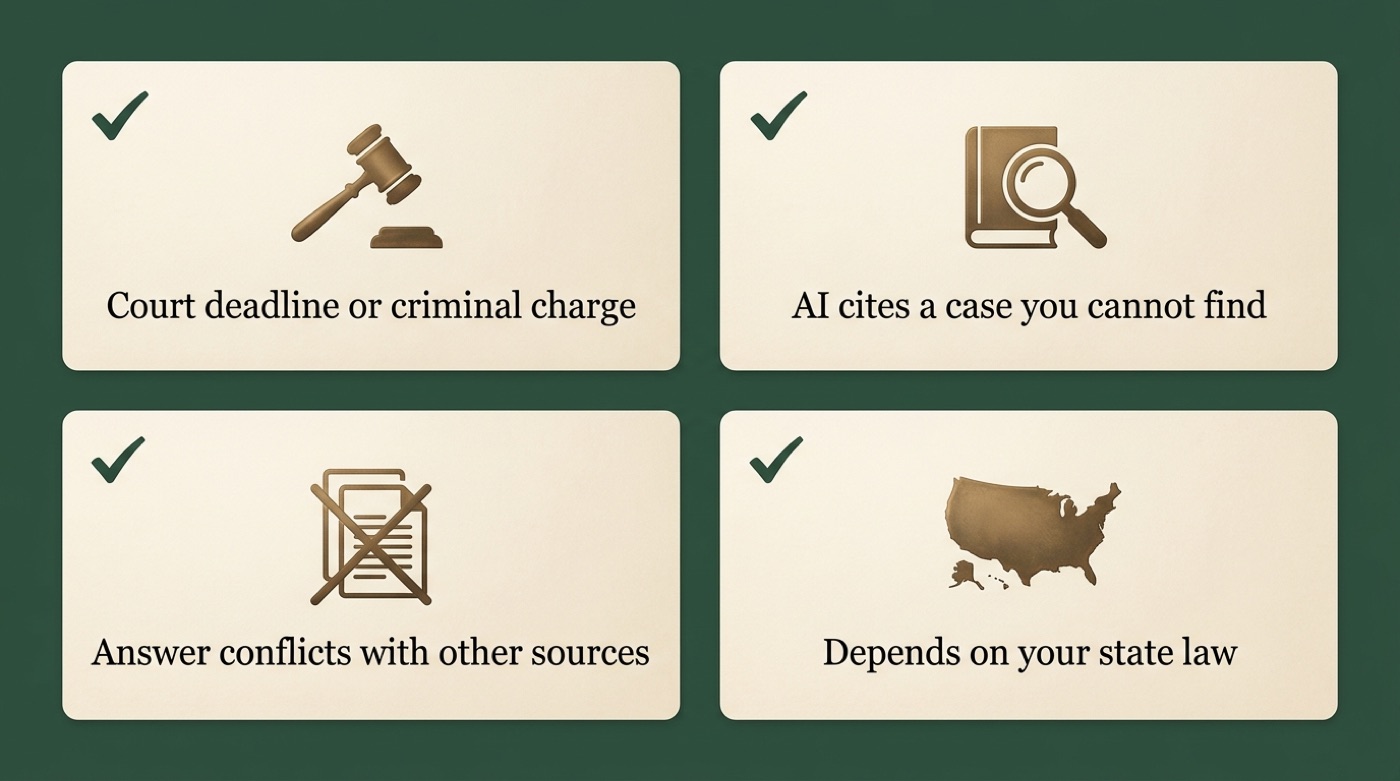
AI outputs can reflect biases baked into training data, and it’s often impossible to fully explain why a model produced a particular answer. For high-stakes situations — immigration matters, custody disputes, criminal charges — that opacity is a risk most people shouldn’t accept. It’s part of why bar associations consistently warn consumers to treat AI legal tools as a starting point, not a final word. The clearest warning signs that an AI answer needs a second, human opinion:
- The matter involves a government agency, court deadline, or criminal exposure
- The AI cites a case, statute, or regulation you can’t independently locate
- The answer conflicts with something you’ve read elsewhere
- The outcome depends on facts specific to your state or local jurisdiction
Is an AI Attorney Confidential? Privacy and Privilege
Confidentiality is where the gap between an AI legal assistant and a real lawyer is easiest to miss — and most costly to get wrong.
Why AI chats are not protected like lawyer conversations
Attorney-client privilege only exists between a client and a licensed attorney. A conversation with an AI chatbot is ordinary data: it may be stored, used to improve the underlying model, or produced in response to a subpoena or discovery request in litigation. In practice, that means anything typed into an AI attorney should be treated as something a stranger could eventually read. A safer approach is to describe a situation hypothetically — without names, case numbers, or admissions — rather than narrating exactly what happened.
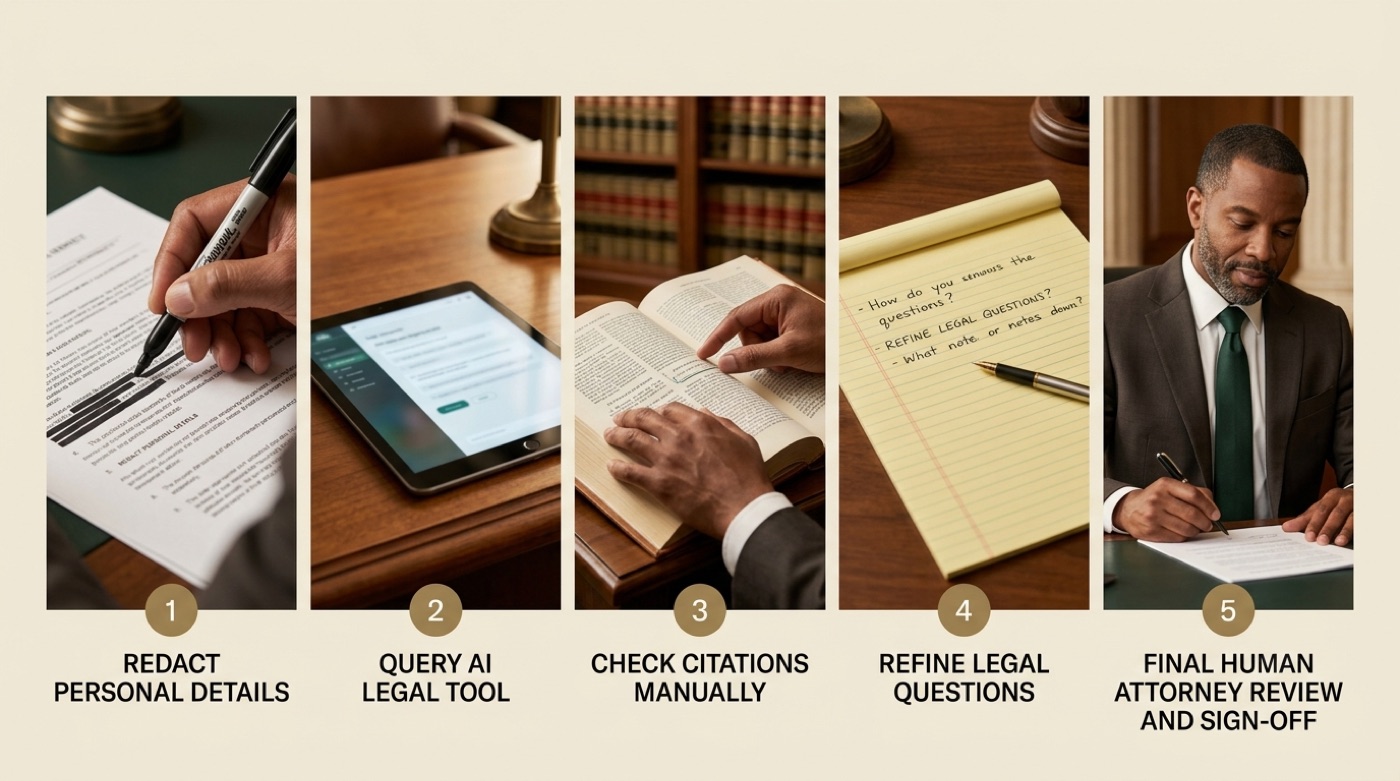
How to use an AI attorney safely
- Strip out names, addresses, case numbers, and anything that could identify you or another party before you start typing.
- Ask the AI attorney to cite the specific statute, regulation, or case it’s relying on — don’t accept an unsourced answer.
- Independently verify any citation or legal claim against a primary source or a licensed attorney before acting on it.
- Use the AI’s output to prepare questions and organize facts, not as your final decision.
- Have a licensed attorney do a final review of anything you plan to sign, file, or send to a counterparty.
- Check the AI tool’s data retention and privacy policy before sharing sensitive details.
Regulators are starting to catch up with this reality. In late October 2025, OpenAI updated its usage policies to bar its models from providing tailored legal advice without the involvement of a licensed professional, and the American Bar Association issued its own guidance — Formal Opinion 512 — in July 2024, addressing how practicing lawyers must handle generative AI tools under existing ethics rules.
Will AI Replace Attorneys? What the Data Says
The numbers suggest transformation, not replacement — at least so far.
Adoption is already mainstream. Clio’s 2025 Legal Trends Report puts lawyer AI adoption at 79% — unchanged from 2024, after jumping from just 19% the year before — with 82% of legal professionals planning to expand their use of it, and adoption highest (87%) at the largest firms.
Productivity gains are compounding, not eliminating jobs. Clio’s research finds that much of legal work is exposed to automation — roughly 57% of the tasks lawyers bill for and up to 81% of legal support work — freeing up time as routine work gets handled by software rather than wiping out roles. Meanwhile, employment for new law school graduates hit a record 93.4% in 2024, suggesting the profession is growing alongside the technology rather than shrinking because of it.
Augmentation, not replacement
The consensus among legal ethics bodies and bar associations is that AI is changing how legal work gets done, not eliminating the need for licensed judgment. Courtroom advocacy, strategic decisions, and professional accountability remain squarely in human hands, while the routine, repeatable parts of legal work move to software.
Better access to justice
The clearest social benefit is access: legal help becomes available to people who could never afford $300-an-hour representation for a first opinion. An AI attorney can close that first gap — understanding your rights, drafting a starting document, or figuring out whether a problem is actually a legal one — even when it can’t close the case itself.
Frequently Asked Questions
- Can an AI attorney replace a real lawyer?
Not for complex or high-stakes matters, but yes for routine tasks like answering questions, drafting first documents, and doing preliminary research. An AI attorney has no law license and carries no professional liability for its output.
- Can an AI attorney represent me in court?
No. Practicing law is licensed, and courts require either a licensed attorney or a self-represented (pro se) party. An AI legal assistant can help you prepare for self-representation, but it cannot appear on your behalf.
- Is it legal to use an AI attorney for legal advice?
Using one is legal — legitimate tools provide ‘legal information,’ not ‘legal advice.’ What’s illegal is a person or service delivering paid legal advice without a license, known as the unauthorized practice of law.
- Are my conversations with an AI attorney confidential?
No. There is no attorney-client privilege with an AI chatbot, and your data can be stored or requested in litigation. Avoid entering identifying details or sensitive case specifics.
- How much does an AI attorney cost?
Typically free to about $20-$200 a month, compared with $300-$800 an hour for a human attorney — a savings of roughly 95-99% on routine tasks like drafting and document review.
- When should I hire a human attorney instead?
For court appearances, criminal charges, immigration cases, custody disputes, and any matter with high financial stakes (roughly $10,000-$100,000 or more), a licensed human attorney is essential.